
AV Perception: The Limitations of Legacy Road Standards
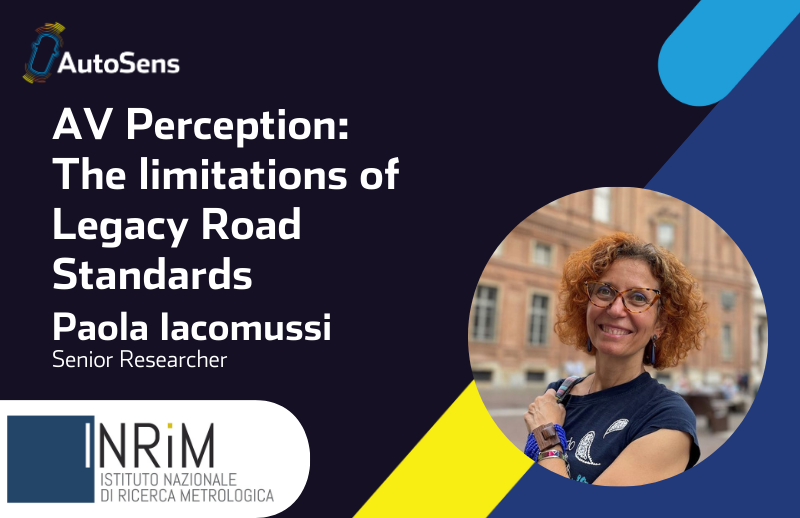
Paola Iacomussi discusses the limitations of current road standards and how shifting to sensor focused frameworks is necessary for the future of AV.
LIPS to Showcase Next-Generation Automotive 3D ToF Cameras and AI Body Pose Solution at AutoSens Europe 2025
LIPS Corporation, a global leader in Robotics Vision Platforms and Edge AI Solutions, will unveil its latest LIPSedge® T225 and T235 automotive 3D ToF camera modules along with the upgraded LIPSense™ Body Pose 7.1.0 solution at AutoSens Europe 2025 (October 7–9).
Next-Gen ADAS: How AI Is Transforming Automotive Imaging

In this Q&A ahead of AutoSens USA, we catch up with Dr. Paul Wu, Head of Automotive Product Marketing, to explore how OMNIVISION is optimizing sensor performance across diverse applications, the impact of AI integration, and their role in NVIDIA’s new AI Systems Inspection Lab.
Expert Viewpoints: Improving Visibility with image sensors for ADAS Systems
In the fast-evolving landscape of autonomous vehicles and ADAS, enhancing visibility through imaging and vision systems remains a critical challenge. Engineers in the field are well aware that the precision and reliability of these systems are paramount to ensuring safety and functionality. Current challenges include dealing with variability in sensor performance, maintaining image quality in low-light and adverse weather conditions, and the limitations of traditional metrics like SNR and dynamic range.
Advancements in active alignment for camera sensors with TRIOPTICS
TRIOPTICS produces a wide range of optical measurement and manufacturing systems, enabling the development, quality control and production of lenses, lens systems and camera modules. In this article, they share the latest update in active alignment technology, with a focus on large scale production.
Automotive Radar Innovations Enable Next-Gen ADAS and Autonomous Driving
How can radar advance to be cost effective, meet safety standards and drive adoption? In this article, Matthias Feulner, Senior Director ADAS at NXP Semiconductors, explores automotive radar innovations that are doing just that. Don’t miss Matthias at AutoSens Brussels, where he’ll be diving deeper into the future of radar.
The Challenge of Designing Systems with High Levels of Autonomy

What system level challenges does the increasing level of compute and sensors now demanded for modern vehicles present? In this article, Shashank Dabral, Lead Platform Architect at Rivian, explores this in the context of body design, sensor cleaning, the camera harness – and the costs of this level of innovation. Shashank highlights key sessions for each feature that are not to be missed at AutoSens Brussels.
In conversation with Uwe Artmann, CTO at Image Engineering
What’s required when making decisions on requirements for designing, testing and producing cameras for automotive? In this article, Uwe Artmann, CTO, Image Engineering and Instructor at the AutoSens Academy, shares how he’ll be diving into this in an in-depth Tutorial at AutoSens Brussels this September. Uwe also explores the benefits of collaboration in our industry, and what it’s like to be part of the AutoSens Academy.
Envisioning the Future Clearly – Article with ASMPT
How can we achieve high performance camera technology that’s profitable? In this article, Envisioning the Future Clearly, Roger V Burns, Senior Director Applications Engineering, ASMPT AEi, uses a representative real camera to explore the manufacturing challenges facing the production of automotive camera.