
Measuring Trust: Why Metrology Matters in Autonomous Vehicle Perception
We spoke to Paola Iacomussi, Senior Researcher at the Italian National Metrological Institute (INRiM) and lecturer at the University of Turin about one of the less-discussed challenges facing ADAS and autonomous vehicle development: how to build truly trustworthy perception systems. Drawing on three decades of experience in metrology, road-environment characterisation and lighting applications, Paola explores why robust perception is not just about adding more scenarios or sensor modalities, but about understanding uncertainty, calibration and the real-world behaviour of sensors under changing environmental conditions.
An Interview with Alex Polonsky: From AI Hype to Real-World Reliability

As AI adoption accelerates across automotive and autonomy, the gap between impressive demonstrations and truly production-ready systems is becoming impossible to ignore.
In this interview, Alex Polonsky, AI Lead Americas at Brose draws on experience spanning motorsport, NASA research, autonomous systems, and enterprise AI to explore what it really takes to build scalable, reliable, and trustworthy AI in safety-critical environments. From governance and validation to systems integration and operational deployment, the conversation cuts through the hype to focus on the engineering discipline required to make AI perform under real-world conditions.
Ahead of his presentation, Software-Defined Vehicle (SDV) to Optimized Zonal Architecture, at AutoSens USA on Thursday 11th June starting at 1:55pm EDT in Room 140A/B, Pramod Kumar a Senior EE Hardware Specialist at Lucid Motors shares his perspective on the architectural shifts shaping the future of EVs, including optimized zonal architectures, centralized compute, and scalable vehicle intelligence platforms
David Doria of Magna International explores how AI is transforming ADAS from system design and development to end-to-end driving models and simulation.
From Software-Defined Vehicles to Optimized Zonal Architectures: Reducing Complexity While Scaling Intelligence
As the automotive industry accelerates toward software-defined vehicles, manufacturers are facing growing challenges around system complexity, scalability, and energy efficiency.
Ahead of his presentation, Software-Defined Vehicle (SDV) to Optimized Zonal Architecture, at AutoSens USA on Thursday 11th June starting at 1:55pm EDT in Room 140A/B, Pramod Kumar a Senior EE Hardware Specialist at Lucid Motors shares his perspective on the architectural shifts shaping the future of EVs, including optimized zonal architectures, centralized compute, and scalable vehicle intelligence platforms
David Doria of Magna International explores how AI is transforming ADAS from system design and development to end-to-end driving models and simulation.
From Lens to System: Scaling Camera Performance for Next-Gen ADAS and Autonomy
As ADAS, autonomous driving, and in-cabin monitoring systems become more advanced, camera technology is no longer just a component- it is a critical foundation for how vehicles perceive and interpret the world. In this Q&A, Dirk Seebaum, Global Product Manager – Automotive at TRIOPTICS, explores how optical performance, calibration, and manufacturing precision directly impact perception quality across the stack.
How AI Is Transforming ADAS Development
AI techniques and tools are beginning to impact every part of the system design, build, and testing process. Each stage is affected in unique ways but enabled by the same underlying advances in technology.
David Doria of Magna International explores how AI is transforming ADAS from system design and development to end-to-end driving models and simulation.
Scaling ADAS Safety with Simulation and Validation
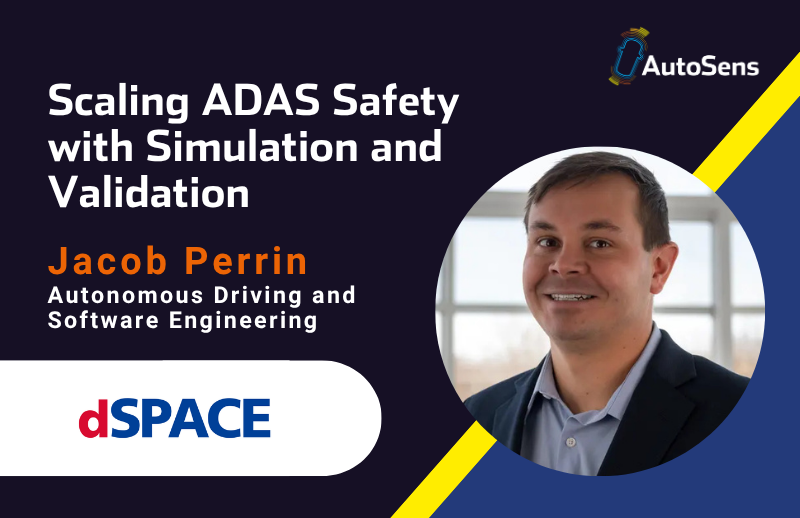
Scaling ADAS safety needs simulation, data-driven validation and less reliance on physical testing to meet real-world and regulatory demands.
Speaker Spotlight: Emily Robb, Stellantis

With automotive perception shifting to centralized compute, new ecosystems are emerging—built on deep collaboration between OEMs, Tier suppliers, and semiconductor partners. At AutoSens USA 2025, Emily Robb, Sr. Fellow at Stellantis, will explore how this shift is reshaping sensor processing, software architecture, and co-development strategies across the supply chain.