
Why Cloud-Chip Integration Is Reshaping Automotive GNSS Positioning
As automated driving systems demand ever higher levels of positioning accuracy and resilience, GNSS architectures are evolving beyond standalone receivers.
Integrating positioning chips, cloud correction services and antennas into a unified ecosystem offers new opportunities to improve reliability, reduce costs and strengthen protection against interference. We spoke with Dr. Hongyang Zhang, Product Manager at BDStar, about the advantages of cloud-chip co-design, the positioning challenges that remain, and how engineers can validate robust, global positioning performance for next-generation vehicles.
Monitoring Automotive Optical Links Before Failures Occur
As automotive networks transition to Optical Ethernet, ensuring link reliability over the lifetime of the vehicle becomes just as important as achieving higher bandwidth.
While automotive optical links are designed to withstand harsh operating conditions, gradual degradation caused by aging, manufacturing defects or physical damage can still affect performance. We spoke with Juan L. Matus, FAE & Customer Support Manager Luis Medina, Field Application Engineer at KD, about the most common causes of optical link degradation, how runtime monitoring can identify issues before communication is affected, and why built-in diagnostics are becoming essential for predictive maintenance in next-generation software-defined vehicles.
From Photon to Perception: Rethinking HDR Validation for Automotive Cameras

High dynamic range (HDR) imaging has become essential for modern ADAS and autonomous driving systems, but producing a visually appealing image does not always result in better perception performance.
Trade-offs between LED flicker mitigation, motion blur, dynamic resolution and low-light performance can significantly affect how reliably vehicles detect and interpret their surroundings. We spoke with Gabriel Bowers, Senior Principal Engineer at Mobileye, about why traditional image quality metrics are no longer enough, how real-world HDR validation should be approached, and why a “photon to KPI” methodology is becoming increasingly important for safety-critical automotive camera systems.
Training the ISP: How Differentiable Imaging Improves Automotive AI
As vehicle perception systems become more dependent on AI, the image pipeline can no longer be treated as a fixed step before the neural network begins.
In this interview, Arm Technical Director – Imaging Alexis Lluis Gomez, explains how differentiable ISPs allow image processing parameters to be optimised directly against perception performance. From reducing manual tuning and adapting to new sensors, to helping preserve model accuracy across changing camera platforms, he explores how task-specific imaging could reshape the route from raw sensor data to production-ready automotive AI.
AutoSens Europe 2026: Top Agenda Picks
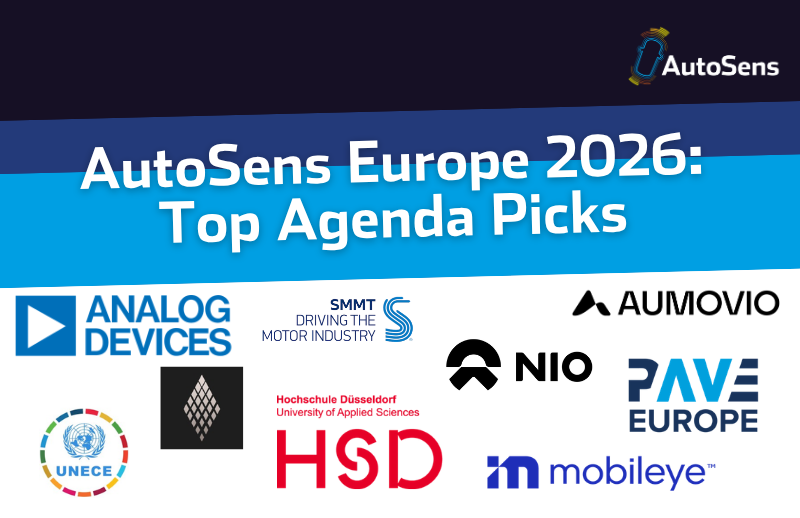
At AutoSens this September, industry experts from Analog Devices, NIO, mobileye, Aumovio & more! will deliver sessions you won’t want to miss!
RAW-Data Injection for ADAS Camera Validation and Homologation
As camera-based ADAS functions take on a greater role in vehicle safety, the quality and realism of the sensor data used to test them becomes increasingly important.
We spoke with Marc Haselhoff, Manager Test Systems Sensors at IPG Automotive, about the advantages of RAW-data injection over traditional over-the-air camera HIL testing, the challenge of maintaining realistic sensor behaviour in closed-loop environments, and why virtual testing is becoming more central to future homologation processes.
Hot Topics: The Top 5 Sessions from AutoSens USA 2026
Recap the top sessions from AutoSens USA 2026, explore the latest advancements, challenges, trends and solutions within the ADAS and AV fields.
An Interview with Nastaran Saberi: Closing the Gap Between Simulation and Reality for ADAS Validation
As simulation becomes increasingly central to ADAS and autonomous vehicle development, the quality of the virtual environment is becoming just as important as the algorithms being tested.
We spoke with Nastaran Saberi, Co-founder and CTO of GeoMate, about the realism challenges that remain, how simulation fidelity should be measured, and why scalable, continuously updated digital environments are key to the future of autonomous driving validation.
The Six Trends Defining the Future of Automotive Sensing
The leading ADAS and AV technology conference returned to Detroit this June – here are the key themes from the day…
AutoSens USA 2026 – Press Conference Recap
Read about the latest automotive technology developments presented at the AutoSens USA conference in June 2026.