
Written by:
Becky Wells
Freelance Automotive Journalist
This June, AutoSens USA returned to Detroit, bringing together automotive engineers, technology developers, OEMs and Tier 1 suppliers working at the forefront of in-cabin sensing, ADAS and automotive electronics. The event was co-hosted with InCabin USA for the third year.
The Press Briefing, held on Wednesday 10th June, showcased the latest developments across interior monitoring, data management and user experience technologies. During the press briefing, exhibitors presented new products and platform developments, designed to address emerging safety regulations, improve vehicle intelligence and accelerate the deployment of next-generation mobility solutions.
Read on for a summary of the key exhibitors at AutoSens USA 2026. For more information about the event and all the exhibitors, head to https://auto-sens.com/usa/
At AutoSens USA 2026, Vueron introduced its Autonomous AI Foundry vision, expanding beyond its origins as a LiDAR perception specialist into a broader provider of AI development infrastructure for autonomous mobility.
Central to the announcement were two new product pillars: Copilot and X Factory. Copilot serves as Vueron’s real-time LiDAR perception platform, providing object detection, tracking and scene understanding capabilities for ADAS and autonomous driving applications.
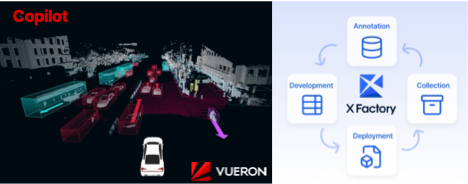
X Factory extends beyond perception to support the complete AI development lifecycle, including data annotation, dataset creation, scenario analysis, model training, validation and deployment. The platform is designed to help engineering teams manage increasingly complex AI workflows required for software-defined vehicles.
Together, the two solutions create an integrated ecosystem that connects vehicle perception with the data-centric development processes necessary to build, validate and deploy autonomous systems at scale.
“Autonomous mobility is no longer defined by sensors alone – the next stage of innovation depends on how effectively companies can transform real-world data into reliable, deployable AI,” said Noah Jang, Senior Vice President of Global Business at Vueron. “With Copilot and X Factory, Vueron is connecting vehicle intelligence with the data-centric AI development workflows needed to build, validate, and scale autonomous systems.”
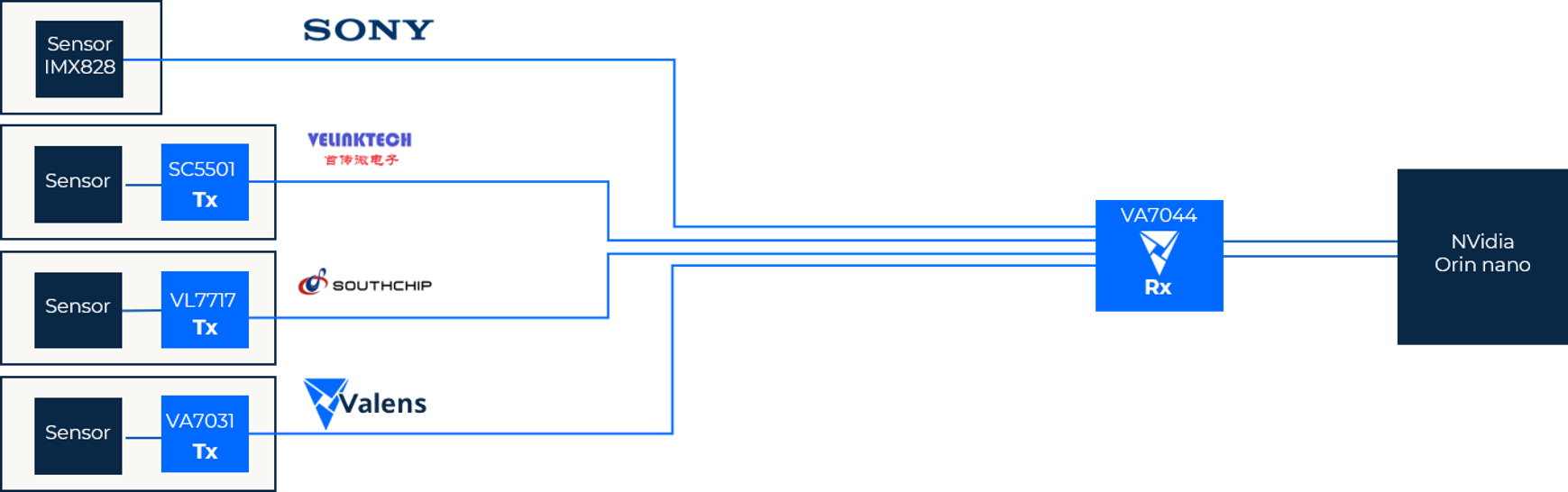
Valens Semiconductor showcased what it described as the automotive industry’s first four-company interoperability demonstration based on the MIPI A-PHY standard.
The demonstration brought together technology from multiple ecosystem partners, including Sony’s IMX828 image sensor, highlighting the growing maturity of A-PHY as a standardised high-speed connectivity platform for next-generation vehicle architectures.
As automotive cameras continue increasing in resolution, dynamic range and frame rates, data bandwidth requirements are rising dramatically. Valens emphasised that proprietary connectivity technologies have historically fragmented the market, while A-PHY offers a standardised alternative designed to deliver high bandwidth, low error rates, end-to-end safety and long-distance connectivity.
The company also highlighted growing ecosystem support for integrated A-PHY implementations, which can reduce system cost, lower power consumption and simplify camera architectures while supporting the next generation of ADAS and automated driving systems.
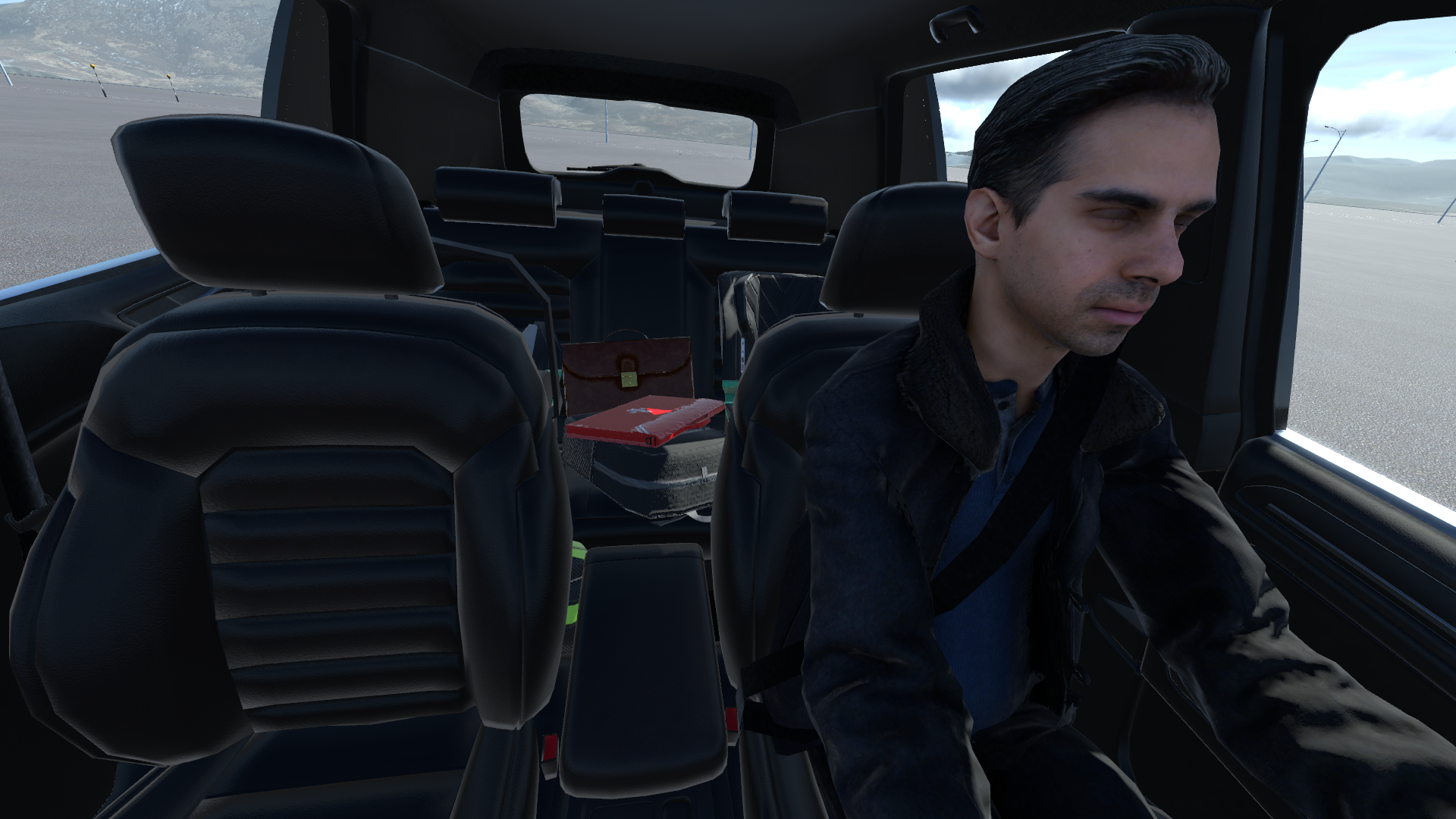
Simulation specialist rFpro made two announcements at this year’s event. The first was ‘AV elevate IN CABIN’, a new simulation environment specifically developed for driver and occupant monitoring system development.
The platform enables OEMs and sensor developers to tune, train and validate monitoring systems before physical prototypes are created. The simulation environment incorporates highly detailed vehicle interiors, radar-aware cabin structures, realistic occupant behaviour and advanced IR camera modelling to replicate real-world sensing conditions.
The second announcement was focused towards AutoSens, as rFpro showcased the integration of Xylon’s ISP Studio within its simulation environment, marking the first time the combined solution has been demonstrated at the event. Building on previous work integrating Sony CMOS sensor technology into simulation workflows, the new capability enables developers to model and fine-tune image signal processor (ISP) parameters directly within a virtual environment.
By incorporating ISP tuning into synthetic data workflows, engineers can evaluate the impact of OEM-specific image processing settings earlier in the development cycle, helping to optimise camera performance, accelerate validation and improve the accuracy of simulation-based testing for ADAS and autonomous driving applications.
Matt Daley, Technical Director at rFpro, said at the conference: “Euro NCAP’s 2026 scoring changes make in-cabin monitoring one of the most consequential areas of vehicle safety development. ‘AV elevate IN CABIN’ is a physically accurate, engineering-grade simulation environment enabling thousands of tests to be conducted before anything physical has even been built. We’re also excited to be debuting Xylon ISP Studio at AutoSens USA this year.”
At AutoSens USA, intoPIX announced that dSPACE will demonstrate the integration of TicoRAW, its implementation of the JPEG XS RAW standard, into a high-performance automotive data logging solution.
As modern ADAS and autonomous vehicle development programmes generate vast volumes of sensor data, this means managing storage, bandwidth and data transfer has become increasingly challenging. The collaboration addresses this problem by compressing RAW sensor data while preserving image fidelity.
The integrated solution enables more efficient storage of high-resolution camera data, extends recording times during vehicle testing and accelerates data transfer to cloud and data centre environments. Early demonstrations have shown successful implementation within dSPACE’s data logging ecosystem, including support for both CPU- and GPU-based processing.
The partnership highlights the growing importance of efficient data management as OEMs and suppliers expand AI training, validation and autonomous driving development programmes.
“The integration of JPEG XS RAW by dSPACE is a key milestone in the deployment of compression across the automotive market,” said Pascal Pellegrin, CTO of the intoPIX Automotive Group. “The challenges raised by the massive amounts of data generated to develop and validate ADAS functionalities require innovative solutions. With JPEG XS RAW, dSPACE and intoPIX are enabling the adoption of efficient storage and transmission at scale.”
indie announced the launch of its iND881 edge AI system-on-chip, a new processor platform designed for intelligent automotive cameras and advanced robotic perception systems.
The device combines a Neural Processing Unit, Digital Signal Processor and quad-core Arm CPU architecture to deliver low-power, real-time AI processing at the edge. The platform supports a wide range of sensing modalities, including visible-light cameras, infrared sensors, thermal imaging, radar, LiDAR and time-of-flight technologies.
For automotive applications, the iND881 targets driver monitoring, occupant monitoring, eMirror systems and other intelligent perception functions. The platform is also designed to support emerging humanoid robotics and industrial automation applications.
indie additionally highlighted integration with emotion3D’s production-proven DMS and OMS software stack, creating a combined hardware-and-software solution that can reduce development complexity and accelerate deployment for OEMs and Tier 1 suppliers.
“With the launch of iND881, we are not only expanding our portfolio but realising the exciting and expansive opportunities in edge AI markets such as automotive and humanoid robotics,” said Fred Jarrar, Senior Vice President, Product Line and Business Management at indie.
“By offering our industry-leading SoC solution as an independent platform or combining it with indie’s emotion3D AI perception software, we are truly differentiating ourselves as a complete solutions provider, while providing customers the flexibility to choose their preferred design approach.”
Dexerials used AutoSens USA to showcase its growing portfolio of sensing and photonics technologies aimed at advanced automotive perception systems.
Drawing on expertise developed in consumer electronics, the company is expanding into automotive sensing through technologies that support cameras, LiDAR and radar systems. Its work is being accelerated through Dexerials Photonics Solution Corporation, which focuses on advanced optical devices and photonic technologies.
A key demonstration at the event combines anti-fogging moth-eye structures with newly developed low-reflection black ink technology. The solution is designed to reduce optical artefacts such as flare and ghosting while preventing sensor degradation caused by condensation and fogging.
Visitors were able to see the technology in action using a live windshield demonstration equipped with front-facing camera systems. The presentation highlighted how advanced materials and optical engineering can improve sensor reliability and image quality, helping support the increasingly demanding requirements of ADAS and automated driving applications.
Conclusion
AutoSens USA 2026 brought together leading automotive technology companies to showcase the latest advances in interior sensing and cabin intelligence. While the individual announcements covered a wide range of technologies, several common themes emerged throughout the event.
Data control, sensor fusion, occupant monitoring and AI-enabled perception featured prominently, reflecting the industry’s requirement to improve safety while reducing system complexity. Many exhibitors highlighted solutions designed to support evolving regulatory requirements while enabling new levels of cabin awareness and user interaction.
To learn more about any of the exhibitors at AutoSens USA 2026, view the full list at https://auto-sens.com/usa/partners/
Interested in in-cabin monitoring technology?
By joining us at AutoSens, you’ll also get full access to our co-located sister event, InCabin. Take a look at the press recap from InCabin USA here >>